-
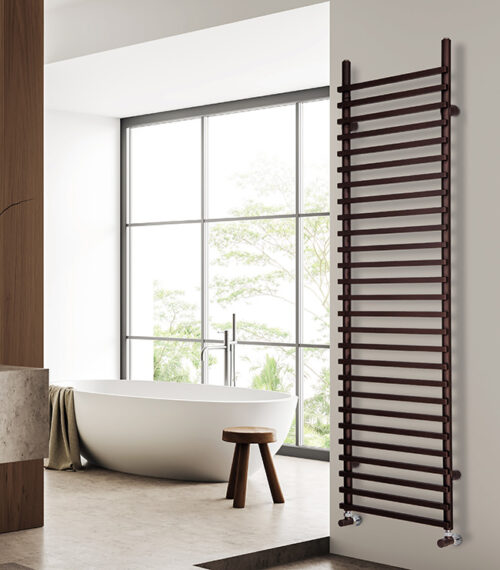
Towel warmer in carbon steel made of a tube with 22 mm diameter. It stands out for its innovative and minimalist design. It is available with low voltage electric operation, a feature that allows it to be installed in high humidity environments such as bathrooms, swimming pools and saunas. It can be installed individually or in side-by-side elements. It is equipped with special hooks for storing and warming towels and bathrobes. Designed to ensure maximum thermal efficiency and energy saving: it is capable of reaching a temperature of 60 °C with the consumption of 20 or 35 watt. Awarded by ADI - Association for Industrial Design with the InOut Hospitality Design Award 2024. “A product designed to offer a welcoming experience, which envelops the user with intuitive features and a minimal design. Thanks to refined aesthetics and perfect technological integration, it guarantees high performance and fluid interaction, creating a harmonious dialogue between form and function."

-
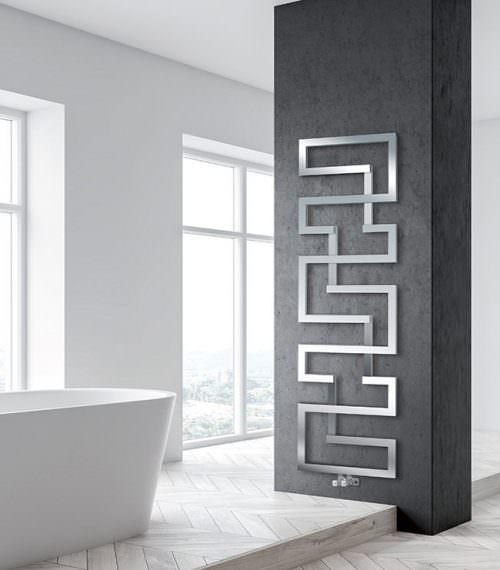
Towel warmer in carbon steel made of a horizontal elements series with 20 mm square section welded on vertical manifolds with 35 mm diameter.
-
Towel warmer in carbon steel made of a horizontal elements series with 16 mm diameter welded on vertical manifolds with 35 mm diameter.
-
Towel warmer in carbon steel made of a horizontal elements series with 16 mm diameter welded on vertical manifolds with 35 mm diameter.
-
Towel warmer in carbon steel made of a horizontal elements series with 20 mm square section welded on vertical manifolds with 35 mm diameter.
-
Towel warmer in carbon steel made of a horizontal elements series with 20 mm square section welded on vertical manifolds with 35 mm diameter.
-
Towel warmer in carbon steel made of a horinzontal elements series with 35 mm diameter welded on vertical manifolds with 35 mm diameter.
-
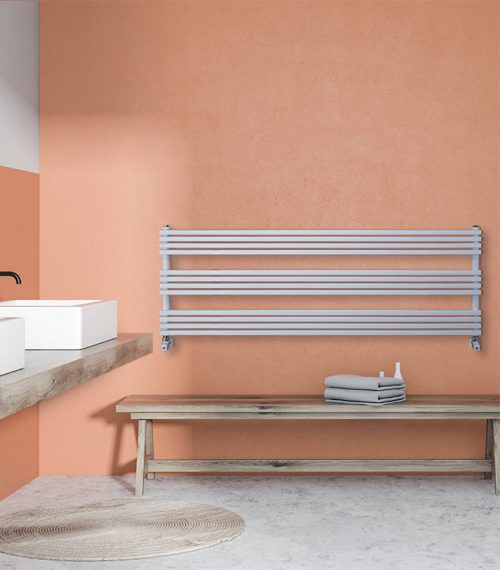
The radiators RAFFAELLO, LEONARDO, MANTEGNA, MASACCIO, BELLINI, TINTORETTO, TIZIANO, MODIGLIANI, BRAMANTE, VERONESE, BRUNELLESCHI, BORROMINI are available in SPACE HORIZONTAL version. It is possible to customize the radiator choosing how to alternate the heating elements with the empty spaces (the empty space corresponds to the space hypothetically taken by the missing heating elements).